Showing posts with label books. Show all posts

Wednesday, 24 June 2015

The First Colonial Soldiers ~~ finally into calm waters

The journey began in May 2013, and by then we though to be back by the end of year. But we were delayed, and we thought it would be summer 2014. However, with so much to explore, so much to chronicle and so much to investigate further the journey was split into two.

The first part of the journey was accomplished in November 2014, with the coverage of the British territories in Europe, think of Dunkirk and Gibraltar, but also the Channel Islands and the Isle of Man, North Africa (Tangier), West Africa (the Gambia, Sierra Leone, the Gold Coast), St Helena, and the factories in East India (present day India and Indonesia).

The second journey ventured West. From the cold and barren Hudson Bay, via the cod fisheries of Newfoundland, the Puritans in New England, to the Dutch and the fur trade in New Netherland, the Swedes in New Sweden, and Quakers in Pennsylvania. The plantation colonies of Maryland, Virginia and Carolina were followed by the island colonies of Jamaica, with of course a narrative of Cromwell's Western Design, the Barbadoes, the Leewards, the Bermudas, and the many smaller settlements, and attempts to settle, in Middle and South America.

And then, the work was done, the journey came to an end and was neatly written down in two volumes, with the second volume in two parts. Together over 100 illustrations and maps, and almost 1,000 pages of text.

Next a short rest, and a glimpse of what is to come next:


Thursday, 28 May 2015

The First Colonial Soldiers, volume 2 ~~ the final chapter

After more than two years of writing, editing and research, the end is near. December 2014 saw the "birth" of Volume 1 of the First Colonial Soldiers, and Volume 2 is being proof-printed as we speak. If everything goes as planned, the books will be available in a few weeks.

As usual these days with final volumes / episodes / parts, it will come in two sub-parts. Stay tuned!


Saturday, 24 January 2015

Winter sale: free shipping when ordering Half pay lists 1699 and 1714 together

In order to make room for new books, no shipping costs will be charged when the two half-pay lists published by Drenth Publishing are ordered together.

See the publisher's site for the details.

This offer is valid as long as stocks last.

Friday, 21 November 2014

The First Colonial Soldiers ~~ almost there

Last September I reported the decision made to deliver the project in two phases. The first phase on the British Isles, Europe, Asia and Africa, and the second phase on the Americas and the Caribbean. The deliverable for each phase should consist of a volume (= book).

Now, two months later, the first volume about to get printed and will be available for sale in December. Only 100 copies will be made, so first come first served!

More, formal, details are found on the publisher's realm (The First Colonials at Publisher's) and a sneak of the cover:


An image from Volume 1 tells it's own story, and this tropical commodity was very much the reason to sail to the other end of the world:


For those interested, here what the cover of Volume 2 is supposed to look like:


The similarity in appearance should not be surprising. Volume 2 will appear in March 2015.

Thursday, 18 September 2014

The First Colonial Soldiers ~~ progressive insights on tackling a large subject

In a previous blog the pending publication of The First Colonial Soldiers was announced. This work, a true Anglo-Dutch joint operation, was scheduled for this autumn.

However, given the lack of existing publications in this area that tackle the subject of colonial soldiering, we ended up with a lot of new information digested into our planned book. Initially the book was thought to number about 400 pages. That became soon 500, and this broke the 600 boundary. With the end only marginally visible.

So, instead of lumping all information into a big volume we decided to split the subject into two volumes:

Volume 1: the British Isles, Europe, Asia and Africa
this volume deals with the several of British possessions in Europe like Dunkirk, Gibraltar and the Channel Islands. It also tackles the beginnings of the British  empire in India and touches on the West African Gold Coast. This volume is to be published in November 2014.

Volume 2: the Americas and the Caribbean
this volumes deals with the colonies in the New World and the temporary holdings in that part of the world. Discussed are the militias of those colonies, the expeditions and battles, the regular forces sent from England, and much more. This volume is to be published in March 2015.

Though designated "Volume 1" and "Volume 2", the volumes can be read independent of each other as each comes with its own introduction, list of references, indices, illustrations and maps.


Tuesday, 10 June 2014

The First Colonial Soldiers ~~ a glimpse of what is to come this summer!


After more than one year of editing, formatting, reading, more editing, sending and receiving more emails to my co-author, re-shuffling, and quite a bit of editing ahead, the project The First Colonial Soldiers is nearing completion! Stay tuned!

Thursday, 21 November 2013

Pending projects ~~ The First Colonial Soldiers

After the relative success of my '1699' and '1714' half-pay lists, the last of which good pretty nice reviews in The Irish Sword and the Journal of the Society of Army Historical Research, a number of new projects were started.

One of these projects will be written together with an Englishman of name, and with a good deal more experience in writing. Apart from the topic, on which more shortly, this cooperation is already very inspiring and instructive.

The topic of this project focusses on colonial soldiering in the 17th and early part of the 18th centuries. Whereas this topic is pretty well covered in literature for the period of the later 18th century (King George's War, the French and Indian Wars), this is much less true for the preceding period.

Thus, the scope of the project is related to the early years of settlement and colonisation of New England, the West Indies and, to a lesser degree, West Africa and the East Indies, and more in particular to the garrisons of these colonies: The First Colonial Soldiers. Also dealt with are 'European' overseas possessions like Gibraltar, Dunkirk and the Channel Islands.

For each colony, or overseas possession, an introductory narrative is provided with the relevant background information on the genesis of that colony. More important, and the main topic of the project, are the 'colonial soldiers', the garrisons in those colonies. Lists of troops are provided, regulars and militia, with dates of commissions and organisational / regimental details. Whereas information on regular troops is - relatively - well known and available, the parts on the various colonial militias are often the result of new research and compilation of information from various sources.

Furthermore, the militia had, almost by definition of being the local form of defence, strong bindings to the local community and administration of the colonies. Reading the history of these militias, and their officers, reads like a history of the colonies.

The First Colonial Soldiers is expected to be published by July 2014. Visit this blog for updates, or check the publisher's site.

Friday, 26 April 2013

Book writing ~~ lessons learned

In little over than one year, two books were compiled by the author of this blog and published by Drenth Publishing.As the two books are on the same subject, half-pay officers, this post will compare both efforts and look into lessons learned and differences between the two projects.

Lessons learned:

  •  Never underestimate your audience. However, don't assume your audience is that well informed into the subject you are writing on as you are. So, it is better to write a bit more on some intricate detail, than leave it out (and: you can always remove it afterwards).
  • Who are the people that will buy your book? Or, putting it a bit differently, know about your target audience. This helps in formulating the scope of the project, and finding additional scope to be covered.
  • If I were a potential customer, what would I want to see in such a book.
  • Be critical to yourself. Re-read what you have written, and question yourself: what is the scope, what is the level of detail, what would a reader expect.
  • So, accept that requirements can change!
  • (Unless you have agreed to someone deliver before a certain time, don't set a hard deadline when there are still things to be sorted out.)
  • (So, communicate the fruits of your labour only when the completion is feasible.)
  • Make a print of the document to see what it looks like on paper, or at least view the document in a two-page modus. This will avoid silly mistakes that makes the project look like a rubbish.

Differences:

  • The second project on the reduced officers for 1699 greatly benefited from technicalities solved in the first project on the half-pay officers for 1714.
  • This meant layout issues: how to present the lists of officers, how to format tables.
  • But it also meant that the design of the cover could be done much quicker.
  • Contact with a printing company was already established.
  • The first project had the benefit of being, partially, based on an existing document. This meant more research time was needed for the second project, even though the information was readily available: the first project run between January and April 2012 (three months), the second between April 2012 and March 2013 (one full year!). 
  • So, where does this extra time from given the 'newby' issues with the first and 'documentation' issues with the second:
    • the second project has an index of officers (should have been done for the first too ...)
    • the introduction in the second project has a more detailed and quantitative approach
    • one appendix was almost a project in itself

When the second project was started, it seemed to be an easy walk-over: the information was present and had 'only' to be arranged and edited. However, during the process the requirements changed a bit by the inclusion of 600+ Huguenot officers, and addition of an index. This explains for a large part the extra time needed.

Now, on to the next project!

Friday, 19 April 2013

A Regimental list of the Reduced officers for the year 1699

Fresh from the press and ready for shipment:

A Regimental list of the reduced officers for the year 1699 
on the English, Scots and Irish Establishments

Please see the publisher's website for more details and ordering information.

This book is the companion volume to the Half-Pay list 1714, that was published in May 2012. Both volumes provide, as the titles indicate, information on the officers that were reduced after the Nine Years' War and War of the Spanish Succession, respectively. But there is more to that. All regiments that were part of the British army, during the respective periods, are detailed (except the subsidy troops), with information on the regimental lineage and a succession of colonels. Moreover, orders of battle are given for a variety of battles, sieges, descents (executed or aborted), expeditions, et cetera.

Tuesday, 26 March 2013

New books forthcoming

Though the new year is almost in its fourth month, the lack of postings did not mean that the author had been idling away his time. A lot of time went to the compilation of a list of the officers reduced after the Nine Years' War. Please see the website here: http://www.drenthpublishing.nl/halfpay1699/halfpay1699.html. The book can already be pre-ordered, and will be ready for shipment in May or June.

Another book will be re-printed, and this will/should be welcomed by anyone with an interest in the British army during the Nine Years' War. The book in question is John Childs' The Nine Years' War and the British army 1688–97. The book was first published in the early 1990s, and long out-of-print since, and hard to find second-hand. This book still is the only modern narrative on the British army on operations in the Low Countries during the Nine Years' War. A thorough review of this book is found here.


Thursday, 31 May 2012

A Regimental list of the half-pay officers for the year 1714

Fresh from the press, and ready for immediate shipment:

A regimental list of the half-pay officers for the year 1714 

Please see an earlier post on for more details, or visit the publisher's site.

Saturday, 28 April 2012

Half-pay list for the year 1714 ~~ republication

Humbly, I wish to announce the forthcoming republication of A regimental list of the half-pay officers for the year 1714. This list, the original, was subject of an earlier post on this blog. This current republication is an annotated and edited version of the original version of 1714. It will be a limited reprint of 50 copies only. The publication is expected to be printed in the second half of May. Pre-orders are already welcomed and accepted.

Please see the publisher's site for more information and contact details.

Thursday, 26 January 2012

Half-pay list of 1714


One of those scarce contemporary publications: A Regimental list of the half-pay officers for the year, 1714. According to the English Short Title Catalogue only less than a dozen copies are known in libraries in Britain and the United States.

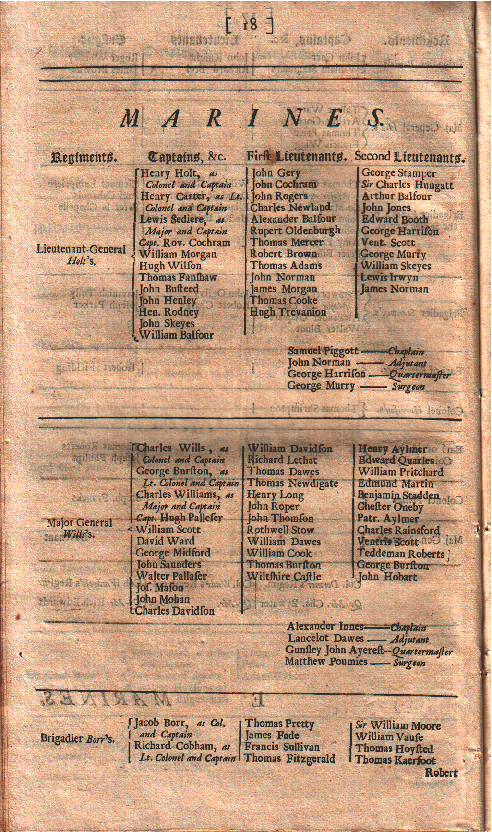
This list, published by order of the House of Commons, shows all officers that were reduced, i.e. placed on half-pay, after the War of the Spanish Succession. And, as such, is a good source for tracing the careers of officers and, of course, the reduction of the army after the war in general. The list gives also an impression of officers available for the military. Not surprisingly, many of the officers are found in the regiments raised under George I after 1715.

Below an example page showing several of the regiments of marines that were disbanded in 1713.


Thursday, 9 June 2011

Book: Bloodline. the origins and development of the regular formations of the British Army


Due to the summer season yet another book review. This time Bloodline, on the origins of the regular regiments and corps of the British Army. It was written by Iain Gordon, founder of Method Publishing and author of several other books on the British armed forces.

At first sight, and compared to the books by Goff Lumley and Gerry Murphy, this book looks not bad at all and may stand the test of trial.

This is partly due to the fact that the book's title does not pretend the books covers anything from the origin of the (modern) of the British Army in 1661 until present day. As such, it is pretty obvious to the reader that this book is intended for those interested in tracing, within limits, the forebears of the present day regiments and corps of the British Army. Nothing more, nothing less.

The regiments and corps are presented in the almost obligatory order of precedence. For each regiment and corps the author give basic lineage information (no full dates nor colonels (except present day)), battle honours, badges and overview of alliances, regimental marches. A nice addition is the inclusion of contact details of the regiments and corps, and regimental museums. So anyone interested in contacting a regiment directly has ample means.

The presentation and layout of the book's content is compact and clear, and the short narratives provide sufficient information to give the reader a basic understanding. A chronological list of battle honours gives this book some additional value.

No good news without bad news, but fortunately I can be brief on this. A very bad first it that this book has no list of references (except for the contact details of the regiments and corps). For me this means this book is not suited very much as a start for further reading into the subject of British regimental lineages. Simply because the author does not guide me into any direction. Secondly, the post-Restoration period is treated too briefly in the narratives in my opinion. This seems to be a recurring thing with many authors. Thirdly, Gordon gives sometimes wrong and strange bits of information in the already short notes on regiments. For example, under the Grenadier Guards, he mentions a Cromwellion invasion of the Netherlands. Elsewhere he states the Scots, or Green Brigade was in Dutch service (later he places them correctly in Swedish service).

Gives the books (limited) scope to present day regiments and their ancestors, it would be unfair of me to make a remark on the neglect of disbanded regiments of the late 17th and early 18th centuries.

The final verdict for this book will be a 7/7.5 out of 10.
Positive: not pretentious regarding the scope of the work, clear and compact information, address/internet details of regiments and corps added value.
Negative: no references given, sloppiness regarding information in notes and narratives resulting in strange and wrong details.

Wednesday, 25 May 2011

Book: Ancestry and Amalgamations in the British Army 1660-2008

About a year ago an earlier book by Goff Lumley was discussed on this blog. As the author really liked that book, given the limited scope and the presentation of regimental information by means of badges, he was happy to see a new book had hit the shelves: Ancestry and Amalgamations in the British Army 1660 - 2008. The hardcover edition is published by Partizan Press, the paperback edition by the Military Library Research Service Ltd.

However, though the book may be nice one way or another, the review given at www.arrse.co.uk is certainly too much praise.

First of all, the book has a strong tendency in interpreting the past with the knowledge of the present time. The present day regiments are taken as starting point, and predecessors are dealt with under that header. Though not terribly bad, a more chronological treatment might have given the reader a better understanding of the growth and life of the British Army.

Secondly, Lumley does not address disbanded regiments of the late 17th and early 18th centuries. That is common with such works, unfortunately. By omitting the regiments that played such an important role in the Nine Years' War and the War of the Spanish Succession, and in bringing the British Army to maturity, the picture of the British Army is incomplete.

As a third point of comment Lumley seems to have been sloppy on a number of details (probably copied mistakes from others). For example, the lineage of the 3rd Regiment of Foot is not correct: the four English regiments in Dutch service did not merge in 1648, and were strictly speaking not disbanded in 1665. Another example is the ranking of the 1st Regiment of Dragoons as 1st as early as 1674! What was to become the Royal Regiment of Dragoons in 1683 was surviving in 1674 in Tangier as horse. And it was in 1674 probably by no means sure that this regiment would survive Tangier, or that it would become dragoons.

A further remark is the lack of a proper introduction. The introduction given informs the reader about the greatness of regiments (the cameraderie, the espirit the corps) and how welcome this book is. It does not tell anything about the origin of the British Army, except that it started in 1660/61. As to dates, the author only gives the year for mergers/amalgamations. Since more detailed information on dates is known, it is a pity Lumley did not put that in.

Finally it should be remarked that the author could have done better with respect to names of colonels. It should be praised that he included the names of colonels of regiments prior to 1751 (a thing often omitted by other authors), but it would have been better had he given full names and titles. As they are presented now it will only confuse people. Also, Lumley exhibits too much an insular English-only attitude towards the history of the British Army, an attitude witnessed by too many other authors of books on the British Army.

To summarize, the book is somewhat a disappointment. With respect to badges, the book is full with pictures of badges which is indeed nice. With respect to (new) information the book is not so new and seems more like a repetition of facts, including some mistakes, compiled in other books. As a positive point the facts on amalgamations after say the 1750 seem to be ok, and Lumley's use of badges to show merges and regimental history is nice.

Those with some interest in the British Army would certainly like the book, and would be easily overwhelmed by it. However, for the more serious student of military history and the British Army the book does not present new information or new insights.

Wednesday, 2 March 2011

English intervention in Catalonia

Thanks to Rampjaar, who pointed me at the following publication:

God save Catalonia

See also this link for more details (which points to the
http://desperta-ferro-ed.blogspot.com/ blog). It is good to have more publications on this somewhat forgotten theater of the War of the Spanish Succession.