A rather wild search on the WWW returned a rather nice article from the hand of professor John Childs on the Scots (Scottish) brigade in service of the Dutch Republic during the 18th Century. The article is of additional interest as it gives sufficient introductory and contextual details on the genesis of the brigade.
The article can be found under the following link:
http://www.dbnl.org/tekst/_doc003198401_01/_doc003198401_01_0004.php
Wednesday, 26 September 2012


Saturday, 22 September 2012
Keeping track of accounts
Working with a non-decimal system can be problematic and confusing. This might be the case when one tries to study financial topics during the early 18th century. In those days, a English pound was divided into 20 shillings, and each shilling numbered 12 pence.
Two tools were created to ease working with this non-decimal system. One is designed to convert a daily payment into its yearly equivalent. In documents on, for example, half-pay officers, the sums paid to these officers is given in daily or yearly sums. The second tool is a simple calculator, to enable addition and subtraction.
The tools can be found at http://drenthpublishing.nl/research.html.
Two tools were created to ease working with this non-decimal system. One is designed to convert a daily payment into its yearly equivalent. In documents on, for example, half-pay officers, the sums paid to these officers is given in daily or yearly sums. The second tool is a simple calculator, to enable addition and subtraction.
The tools can be found at http://drenthpublishing.nl/research.html.
Monday, 3 September 2012
The pity of war
The Calendar of Treasury Books are a real goldmine for all kinds of detail on regiments, their movements, payments due to regiments, etc etc. One will also find many details related to individuals. Sometimes in the form of a petition, when officers from a regiment reduced long ago demanded payment of arrears. In this post the example of a pension granted to a captain who had to leave active service because of illness. This captain had to wait, and suffer, for more than four years for his pension, because of some mistake in the bureaucratic machinery.
Royal warrant dated St. James's [to the Lord Lieutenant of Ireland] to insert on the list of French pensioners on the Establishment of Ireland the name of Moses Caries with 3s. a day pension as from Sept. 29 last, he having been Capt. of a Company in the late Foot Regiment of Col. Charles Dubourgay, and being by sickness and other infirmities contracted in the service rendered unable to repair to his post in Spain, whereupon the late Queen granted him a pension of 3s. a day on the Establishment of Ireland in lieu of his Company, but the said Queen's warrant for that purpose to the Marquess of Wharton, then Lieutenant General of Ireland, being by mistake countersigned by Robert Walpole, then Secretary at War, whereby said Caries could never obtain any benefit of the said pension, whereby he has been there 4½ years in a starving condition, being now bedridden and almost blind. Out Letters (Ireland) IX, p. 622.This makes one wonder about the fate to ordinary soldiers, who had fallen ill during service. (Excerpt taken from Warrant Books, February 1715, Calendar of Treasury Books, Volume 29.)
new book: Marlborough: Soldier and Diplomat
The author was recently notified on a new publication on the Duke of Marlborough: Marlborough: Soldier and Diplomat. Other than previous publications, in which Marlborough is typically seen by, through and for British perspective, this publication places Marlborough in a much wider, European, context. A dozen specialists have written on the Duke, each from a different perspective.
The book is edited by John B. Hattendorf, Augustus J. Veenendaal, and Rolof van Hövell tot Westerflier. Contributing authors include David Onnekink from the Netherlands, John Hattendorf, Jamel Ostwald, and John Stapleton from the United States, and Alan Guy and Tony Claydon from the United Kingdom.
The book is published by Karwansaray Publishers, and more information on the book is found here. Judging from the topics covered, the book looks like a 'must-read' and one will eventually find its way to the author's library.
The book is edited by John B. Hattendorf, Augustus J. Veenendaal, and Rolof van Hövell tot Westerflier. Contributing authors include David Onnekink from the Netherlands, John Hattendorf, Jamel Ostwald, and John Stapleton from the United States, and Alan Guy and Tony Claydon from the United Kingdom.
The book is published by Karwansaray Publishers, and more information on the book is found here. Judging from the topics covered, the book looks like a 'must-read' and one will eventually find its way to the author's library.
Sunday, 12 August 2012
Danish Troops in the Williamite Army in Ireland, 1689-91 ~~ by Klejd Hald Galster
There is not much literature on the Nine Years War, there seems to be even less on the Williamite War in Ireland between 1689 and 1691. A couple of years ago John Childs wrote The Williamite Wars in Ireland. This was a welcome scholarly piece of work on this episode during the Nine Years War, and may be considered a standard work. Furthermore, there are monographs on particular battles. such are Mike McNally's books on the battles of the Boyne and Aughrim.
Recently another book was published, namely Danish troops in the Williamite army in Ireland, 1689-91 by Kjeld Hald Galster. Apart for providing a narrative of the war in Ireland during 1689-91, this book gives also a first hand account of subsidy troops and fills in an important gap in the literature. In 17th and 18th century warfare subsidy troops (hilfstruppen) played an important role, even made up a substantial part of the Williamite, and later Marlburian, armies in Flanders. However, there is no single monograph on any of these subsidy troops, as far as I am aware, and this on the Danish contingent is very welcome.

The author, Kjeld Hald Galster, did a very good job here to clarify the genesis and role of these Danish troops as part of the Williamite forces in Ireland. Gold played, obviously, an important role for Christian V of Denmark when he hired out 7,000 of his troops to William III of England. However, Galster makes clear other, politically motivated, factors played an equally important role. Hiring out troops was also an opportunity for the army to gain experience.
Galster provides the reader with a theoretical framework for warfare, considerations that needed to be taken by commanders, etc. In particular coalition warfare, and the role of the Danish contingent, is given much attention. Regarding the latter, the author frequently reference to modern day wars where so-called coalitions of the willing are important for an international community to achieve certain goals (cf. peace-keeping operations or operations in Iraq and Afghanistan).
On a more detailed level, this book narrates on the operations in Ireland between, roughly speaking, the arrival of the Danish troops in early 1690 until the signing of the Treaty of Limerick in late 1691. Here, Galster makes ample use of documents from the Danish State Archives (Rigsarkivet), hitherto unpublished material. This all should appeal to anyone interested in the conduct of operations during the Williamite Wars. Problems related to reinforcements and payments seem an almost continuous theme.
For a work of such a scope, or actually such a detailed and well-defined topics, it is almost unavoidable that some loose ends and minor issues remain.
First there is the role Denmark would have played as part of the coalition against France that may have needed some more explanation. Though Denmark supplied of course some 7,000 men, Denmark was, as far as I know, not a member of the League of Augsburg or Grand Alliance against France.
Secondly, as the story of the Danish troops is set against that of the Glorious Revolution, the latter is detailed a bit as well. However, here there seems a preference for the 'invitation/conspiracy' theory, neglecting other theories stating that William of Orange's invasion of England was more a pre-emptive strike.
Looking at the welcome tables and illustrations, a few remarks may be made. On page 60 a chart is given on the organization of the Williamite forces.
Here the presence of a Brandenburg regiment is bit odd. Of course, this refers to the Regiment Brandenburg, a regiment of the Dutch standing army. It was not, for example, a (subsidy) regiment from the Brandenburg army. Hence, it should be be listed as part of the 'regiments of Dutch infantry'. The Brandenburg regiment is listed separately in the appendix as well. Looking at the other regiments of cavalry, Schomberg's regiment was a Huguenot regiment but is not listed as such (the Huguenot foot is).
The appendix with Danish regiments is particular nice. I was pleased to find the names of various French officers, Huguenots refugees. As a lineage aficionado I regret there is not more regimental detail on the nine Danish regiments of foot that each supplied one battalion. But something needs to be wished for of course!
But that is all minor compared to the rest of this work. The addition of a book on the Williamite War in Ireland is always welcome. Though the book's main character, the Danish contingent, may be a bit esoteric, it provides a very nice perspective on the operations and conduct of warfare in Ireland between 1690 and 1691. The discussion of topics such as coalition warfare, and the role of the Danes, as an abstraction makes this book stand out as being more than a, for example, regimental history.
This book is therefor highly recommended to anyone with an interest in this period. The book can easily be obtained via the published: the Four Courts Press.
Recently another book was published, namely Danish troops in the Williamite army in Ireland, 1689-91 by Kjeld Hald Galster. Apart for providing a narrative of the war in Ireland during 1689-91, this book gives also a first hand account of subsidy troops and fills in an important gap in the literature. In 17th and 18th century warfare subsidy troops (hilfstruppen) played an important role, even made up a substantial part of the Williamite, and later Marlburian, armies in Flanders. However, there is no single monograph on any of these subsidy troops, as far as I am aware, and this on the Danish contingent is very welcome.
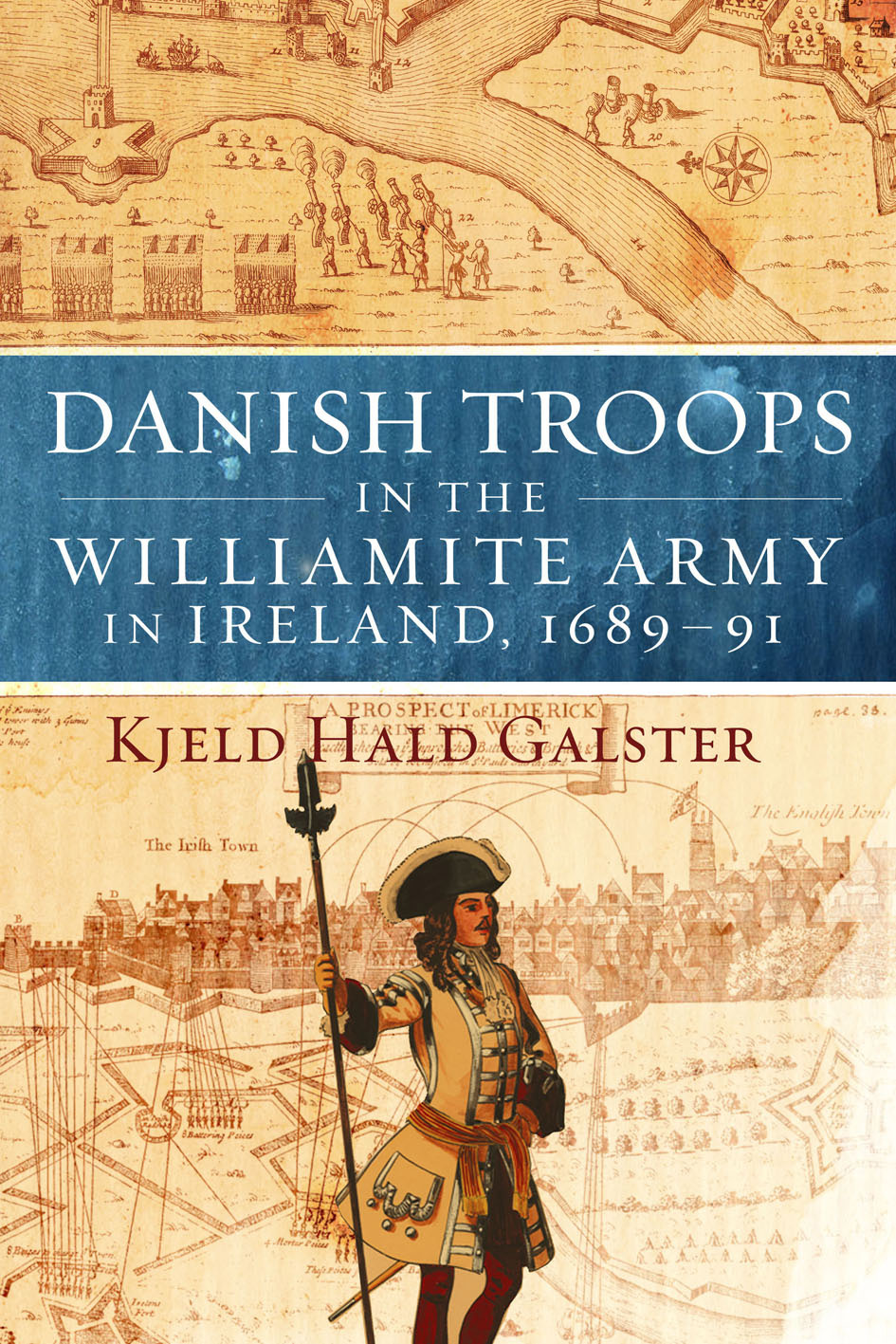
The author, Kjeld Hald Galster, did a very good job here to clarify the genesis and role of these Danish troops as part of the Williamite forces in Ireland. Gold played, obviously, an important role for Christian V of Denmark when he hired out 7,000 of his troops to William III of England. However, Galster makes clear other, politically motivated, factors played an equally important role. Hiring out troops was also an opportunity for the army to gain experience.
Galster provides the reader with a theoretical framework for warfare, considerations that needed to be taken by commanders, etc. In particular coalition warfare, and the role of the Danish contingent, is given much attention. Regarding the latter, the author frequently reference to modern day wars where so-called coalitions of the willing are important for an international community to achieve certain goals (cf. peace-keeping operations or operations in Iraq and Afghanistan).
On a more detailed level, this book narrates on the operations in Ireland between, roughly speaking, the arrival of the Danish troops in early 1690 until the signing of the Treaty of Limerick in late 1691. Here, Galster makes ample use of documents from the Danish State Archives (Rigsarkivet), hitherto unpublished material. This all should appeal to anyone interested in the conduct of operations during the Williamite Wars. Problems related to reinforcements and payments seem an almost continuous theme.
For a work of such a scope, or actually such a detailed and well-defined topics, it is almost unavoidable that some loose ends and minor issues remain.
First there is the role Denmark would have played as part of the coalition against France that may have needed some more explanation. Though Denmark supplied of course some 7,000 men, Denmark was, as far as I know, not a member of the League of Augsburg or Grand Alliance against France.
Secondly, as the story of the Danish troops is set against that of the Glorious Revolution, the latter is detailed a bit as well. However, here there seems a preference for the 'invitation/conspiracy' theory, neglecting other theories stating that William of Orange's invasion of England was more a pre-emptive strike.
Looking at the welcome tables and illustrations, a few remarks may be made. On page 60 a chart is given on the organization of the Williamite forces.
Here the presence of a Brandenburg regiment is bit odd. Of course, this refers to the Regiment Brandenburg, a regiment of the Dutch standing army. It was not, for example, a (subsidy) regiment from the Brandenburg army. Hence, it should be be listed as part of the 'regiments of Dutch infantry'. The Brandenburg regiment is listed separately in the appendix as well. Looking at the other regiments of cavalry, Schomberg's regiment was a Huguenot regiment but is not listed as such (the Huguenot foot is).
The appendix with Danish regiments is particular nice. I was pleased to find the names of various French officers, Huguenots refugees. As a lineage aficionado I regret there is not more regimental detail on the nine Danish regiments of foot that each supplied one battalion. But something needs to be wished for of course!
But that is all minor compared to the rest of this work. The addition of a book on the Williamite War in Ireland is always welcome. Though the book's main character, the Danish contingent, may be a bit esoteric, it provides a very nice perspective on the operations and conduct of warfare in Ireland between 1690 and 1691. The discussion of topics such as coalition warfare, and the role of the Danes, as an abstraction makes this book stand out as being more than a, for example, regimental history.
This book is therefor highly recommended to anyone with an interest in this period. The book can easily be obtained via the published: the Four Courts Press.
Friday, 10 August 2012
Comics on the Peace of Utrecht
Some time ago a Dutch website devoted to the Peace of Utrecht was discussed on this blog. Apparently, a series of comics on this peace treaty, and the preceding war, is made by various artists. Several sample pages can be found at the following url:
http://www.vredevanutrecht2013.nl/Home/Over/Vrede-van-Utrecht-Stript.aspx
It is nice to see such attention to this important event in European history.
The text is in Dutch only, but I think that the drawings are clear enough.The text, and coverage of historical events, seem to suffer a bit from oversimplification (only judging from these few sample pages). Somehow Germany existed already in 1700 and, there is the suggestion that the war was between France and German, with England and the Dutch Republic helping Germany.
But fair enough, it is not an Osprey publication :-)
http://www.vredevanutrecht2013.nl/Home/Over/Vrede-van-Utrecht-Stript.aspx
It is nice to see such attention to this important event in European history.
The text is in Dutch only, but I think that the drawings are clear enough.The text, and coverage of historical events, seem to suffer a bit from oversimplification (only judging from these few sample pages). Somehow Germany existed already in 1700 and, there is the suggestion that the war was between France and German, with England and the Dutch Republic helping Germany.
But fair enough, it is not an Osprey publication :-)
Thursday, 19 July 2012
Marine regiments and their use
Two regiments of marines were raised in January 1690. One was commanded by Arthur Herbert, the Earl of Torrington, and the other by Thomas Herbert, the Earl of Pembroke. Both regiments consisted of 15 companies with about 100 men in each company.
The Calendar of State Papers Domestic: William and Mary, 1689-90 give some nice background information on how these two big regiments should be employed, both at sea and on land. From the text it is not entirely clear if this way of working is to be implemented during the Winter season only, or round the year as well.
A first interesting detail is the division of each regiment into three battalions of 500 men each, with each battalion having a distinct purpose.The first battalion is to be on board of ships, or be quartered as close a possible to enable speedy embarkation. The second battalion should be employed at shipyards, and the third should be put in
The Calendar of State Papers Domestic: William and Mary, 1689-90 give some nice background information on how these two big regiments should be employed, both at sea and on land. From the text it is not entirely clear if this way of working is to be implemented during the Winter season only, or round the year as well.
A first interesting detail is the division of each regiment into three battalions of 500 men each, with each battalion having a distinct purpose.The first battalion is to be on board of ships, or be quartered as close a possible to enable speedy embarkation. The second battalion should be employed at shipyards, and the third should be put in
garrisons or quarters of refreshment within the country, where they are to attend only to military discipline, and exercise as soldiers.Another interesting detail is the annual rotation of battalions doing the various duties. Thus, in a few years time the regiment on a whole is (expected to be) experienced in duties both at sea and on land. Drafts from these two regiments should bring knowledge into the rest of the armed forces:
it being one of the chief ends of this establishment that these regiments may prove "nurseries" whence the several necessities of their Majesties' service may be abundantly supplied.A last observation is that the regiments should be trained and equipped as grenadiers. With the remarks that hand grenades have had good effect at sea, but also on land against horses.
for it is apparent that hand grenades would be of admirable effect, on many occasions at sea, and it is visible how useful they would be as to other purposes, particularly against the approaches of the horse in the country of an enemy.
Subscribe to:
Posts (Atom)

 Posts
Posts