Sunday, 12 August 2012

Danish Troops in the Williamite Army in Ireland, 1689-91 ~~ by Klejd Hald Galster

There is not much literature on the Nine Years War, there seems to be even less on the Williamite War in Ireland between 1689 and 1691. A couple of years ago John Childs wrote The Williamite Wars in Ireland. This was a welcome scholarly piece of work on this episode during the Nine Years War, and may be considered a standard work. Furthermore, there are monographs on particular battles. such are Mike McNally's books on the battles of the Boyne and Aughrim.

Recently another book was published, namely Danish troops in the Williamite army in Ireland, 1689-91 by Kjeld Hald Galster. Apart for providing a narrative of the war in Ireland during 1689-91, this book gives also a first hand account of subsidy troops and fills in an important gap in the literature. In 17th and 18th century warfare subsidy troops (hilfstruppen) played an important role, even made up a substantial part of the Williamite, and later Marlburian, armies in Flanders. However, there is no single monograph on any of these subsidy troops, as far as I am aware, and this on the Danish contingent is very welcome. 
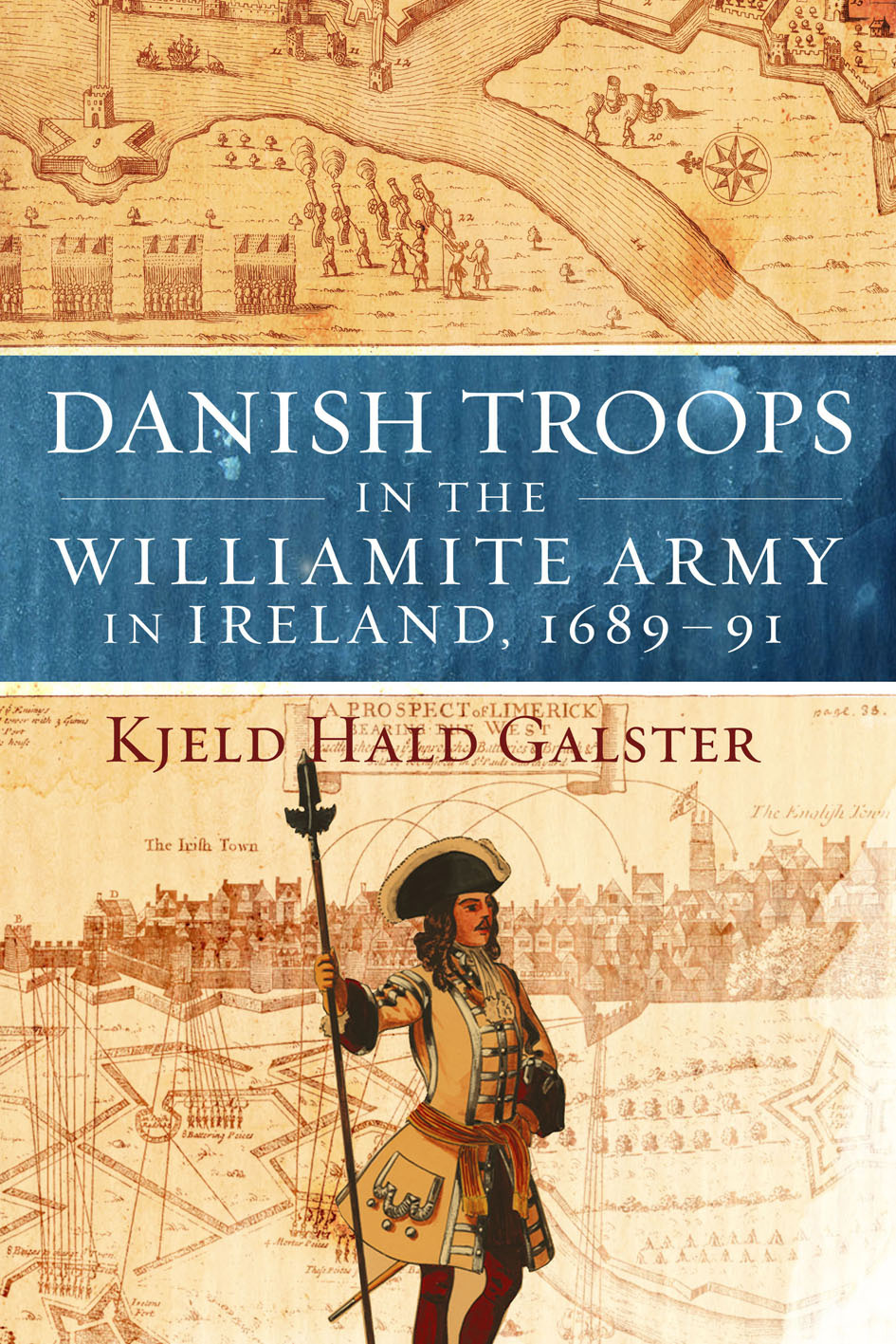

The author, Kjeld Hald Galster, did a very good job here to clarify the genesis and role of these Danish troops as part of the Williamite forces in Ireland. Gold played, obviously, an important role for Christian V of Denmark when he hired out 7,000 of his troops to William III of England. However, Galster makes clear other, politically motivated, factors played an equally important role. Hiring out troops was also an opportunity for the army to gain experience.

Galster provides the reader with a theoretical framework for warfare, considerations that needed to be taken by commanders, etc. In particular coalition warfare, and the role of the Danish contingent, is given much attention. Regarding the latter, the author frequently reference to modern day wars where so-called coalitions of the willing are important for an international community to achieve certain goals (cf. peace-keeping operations or operations in Iraq and Afghanistan).

On a more detailed level, this book narrates on the operations in Ireland between, roughly speaking, the arrival of the Danish troops in early 1690 until the signing of the Treaty of Limerick in late 1691. Here, Galster makes ample use of documents from the Danish State Archives (Rigsarkivet), hitherto unpublished material. This all should appeal to anyone interested in the conduct of operations during the Williamite Wars. Problems related to reinforcements and payments seem an almost continuous theme.

For a work of such a scope, or actually such a detailed and well-defined topics, it is almost unavoidable that some loose ends and minor issues remain.
 
First there is the role Denmark would have played as part of the coalition against France that may have needed some more explanation. Though Denmark supplied of course some 7,000 men, Denmark was, as far as I know, not a member of the League of Augsburg or Grand Alliance against France.

Secondly, as the story of the Danish troops is set against that of the Glorious Revolution, the latter is detailed a bit as well. However, here there seems a preference for the 'invitation/conspiracy' theory, neglecting other theories stating that William of Orange's invasion of England was more a pre-emptive strike.

Looking at the welcome tables and illustrations, a few remarks may be made. On page 60 a chart is given on the organization of the Williamite forces.
Here the presence of a Brandenburg regiment is bit odd. Of course, this refers to the Regiment Brandenburg, a regiment of the Dutch standing army. It was not, for example, a (subsidy) regiment from the Brandenburg army. Hence, it should be be listed as part of the 'regiments of Dutch infantry'. The Brandenburg regiment is listed separately in the appendix as well. Looking at the other regiments of cavalry, Schomberg's regiment was a Huguenot regiment but is not listed as such (the Huguenot foot is).

The appendix with Danish regiments is particular nice. I was pleased to find the names of various French officers, Huguenots refugees. As a lineage aficionado I regret there is not more regimental detail on the nine Danish regiments of foot that each supplied one battalion. But something needs to be wished for of course!

But that is all minor compared to the rest of this work. The addition of a book on the Williamite War in Ireland is always welcome.  Though the book's main character, the Danish contingent, may be a bit esoteric, it provides a very nice perspective on the operations and conduct of warfare in Ireland between 1690 and 1691. The discussion of topics such as coalition warfare, and the role of the Danes, as an abstraction makes this book stand out as being more than a, for example, regimental history.

This book is therefor highly recommended to anyone with an interest in this period. The book can easily be obtained via the published: the Four Courts Press.

Friday, 10 August 2012

Comics on the Peace of Utrecht

Some time ago a Dutch website devoted to the Peace of Utrecht was discussed on this blog. Apparently, a series of comics on this peace treaty, and the preceding war, is made by various artists. Several sample pages can be found at the following url:
http://www.vredevanutrecht2013.nl/Home/Over/Vrede-van-Utrecht-Stript.aspx
It is nice to see such attention to this important event in European history.

The text is in Dutch only, but I think that the drawings are clear enough.The text, and coverage of historical events, seem to suffer a bit from oversimplification (only judging from these few sample pages). Somehow Germany existed already in 1700 and, there is the suggestion that the war was between France and German, with England and the Dutch Republic helping Germany.
But fair enough, it is not an Osprey publication :-)

Thursday, 19 July 2012

Marine regiments and their use

Two regiments of marines were raised in January 1690. One was commanded by Arthur Herbert, the Earl of Torrington, and the other by Thomas Herbert, the Earl of Pembroke. Both regiments consisted of 15 companies with about 100 men in each company.

The Calendar of State Papers Domestic: William and Mary, 1689-90 give some nice background information on how these two big regiments should be employed, both at sea and on land. From the text it is not entirely clear if this way of working is to be implemented during the Winter season only, or round the year as well.

A first interesting detail is the division of each regiment into three battalions of 500 men each, with each battalion having a distinct purpose.The first battalion is to be on board of ships, or be quartered as close a possible to enable speedy embarkation. The second battalion should be employed at shipyards, and the third should be put in
garrisons or quarters of refreshment within the country, where they are to attend only to military discipline, and exercise as soldiers.
Another interesting detail is the annual rotation of battalions doing the various duties. Thus, in a few years time the regiment on a whole is (expected to be) experienced in duties both at sea and on land. Drafts from these two regiments should bring knowledge into the rest of the armed forces:
it being one of the chief ends of this establishment that these regiments may prove "nurseries" whence the several necessities of their Majesties' service may be abundantly supplied.
A last observation is that the regiments should be trained and equipped as grenadiers. With the remarks that hand grenades have had good effect at sea, but also on land against horses.
for it is apparent that hand grenades would be of admirable effect, on many occasions at sea, and it is visible how useful they would be as to other purposes, particularly against the approaches of the horse in the country of an enemy.

Monday, 16 July 2012

Regiment Brandenburg / Lehndorff

In many stories on the invasion of England by the Prince of Orange in November 1688, and the ensuing campaign in Ireland, one will see ample reference to a Brandenburg regiment part of the Dutch forces. This regiment was not an auxiliary, or subsidy, regiment, as is sometimes thought, but a regiment of the Dutch standing army.

This regiment was raised in 1673 by Ahasverus von Lehndorff, a nobleman from eastern Prussia, for Dutch service. This regiment was probably composed of Poles. Lehndorff quitted Dutch service in 1676, and his regiment was afterwards commanded by a son of the Elector of Brandenburg. From which time we read about a Regiment Brandenburg in Dutch service. The employment of subsidy troops from Brandenburg during the Nine Years' War and the War of the Spanish Succession may very well be confusing.

A biography on this Ahasverus von Lehndorff is found at Google Books: Der Oberburggraf Ahasverus von Lehndorff. Judging from the table of contents, he had a varied military career, serving the king of Poland, the king of Denmark, and, course, Brandenburg and the Dutch Republic.


Friday, 13 July 2012

Equipping the artillery train for Flanders in 1702

The Journals of the House of Commons are an important source of information for those looking for numbers and financial matters. War needed to be paid, and paid by someone, and the list with annual estimates for the armed forces are very useful.

Volume 13 of this journal gives us some insight in the genesis of the train of artillery that was being prepared for service in Flanders in early 1702. Everything, from the number of sakers, fourteen of them, to the number of horse shoe nails, 18000, is listed. The estimated cost for everything is listed as well (£9 for the nails, £3,075 for the sakers). A list of spare parts for the army carried by the train is given as well. Taken along were, amongst other items, 3000 snaphance muskets, 1000 long pikes and 400000 flints. The total cost for all equipment was a little over £34,806! The officers and men required an additional £10,630 12 0 per year, and the cost for horses amounted to £16,000 for half a year.

Material needed by the mortars (glue-kettels, 2 reams of paper, amongst a few dozen other items).
All in all this list gives a fascinating overview of the amount of stuff needed by a (not so big) train of artillery 300 years ago. It also illustrates the technical nature of the ordnance (lots and lots of tools and nails). I have found no list of stuff that was carried (officially) by, say, a regiment of foot to compare with, unfortunately.

This volume of the Journals of the House of Commons is found at Google Books, with said overview found on pages 690 - 695.

Thursday, 31 May 2012

A Regimental list of the half-pay officers for the year 1714

Fresh from the press, and ready for immediate shipment:

A regimental list of the half-pay officers for the year 1714 

Please see an earlier post on for more details, or visit the publisher's site.

Saturday, 12 May 2012

Battle of Neerwinden 29 July 1693 ~~ British regiments

The English language wiki on the Battle of Neerwinden conveniently gives an order of battle of the British regiments present at that battle. Unfortunately, that order of battle uses (more) modern titles for the regiments, unknown in 1693. The section's title ('English, Scottish and Irish Order of Battle') may make the reader think there were separate English, Scottish and Irish components in the army in Flanders. Though there were English, Scottish and Irish regiments, they were all on the English Establishment. There are some minor inaccuracies as well.

Presented here is a somewhat revised order of battle is given, with 17th century titles (i.e., understandable for contemporaries and EMEMH-ians). A more modern title, usually the territorial designation valid for around 1900, is given between brackets and should be understood by the younger generations.

The corrections were largely made using d'Auvergne's account of the campaign of 1693, and Walton's history of British Standing Army.

Cavalry

- Life Guards - three squadrons: 1st, 3rd and 4th Troops of Life Guards. The latter one was actually the Dutch Garde du Corps. This unit came over to England in 1688, and was on the English Establishment between 1689 and 1699. In England it ranked as the 4th Troop of Life Guards. The regimentation of these three troops may have been for convenience and tactical purposes only. The wiki shows the Royal Horse Guards, which were in England in 1693 and should be considered an error.
- The Queen's Regiment of Horse - 3 sqns (1st Dragoons Guards)
- Lord Berkeley's Regiment - 2 sqns (3rd Dragoons Guards)
- Francis Langston's Regiment - 2 sqns (4th Dragoons Guards)
- Hugh Wyndham's Regiment - 2 sqns (6th Dragoons Guards)
- Earl of Galway's Regiment - 3 sqns (a Huguenot regiment, disbanded in 1699 and not in the wiki)

Lord Fitzharding's Regiment of Dragoons - 3 sqns (4th Dragoons)

Foot

- First Regiment of Foot Guards - 2 bns (later Grenadier Guards) 
- Coldstream Regiment of Foot Guards - 1 bn (Coldstream Guards)
- Scots Regiment of Foot Guards - 2 bns (Scots Guards)
- Royal Regiment of Foot - 2 bns (Royal Scots)
Remark: it should be remarked that the battalions of the regiments of guards were temporary, tactical, formations, and not necessarily distinctive, ever-present and unchanging administrative formations as we came to know battalions at a later period. The Royal Regiment, however, was really organised into two battalions.
- William Selwyn's Regiment of Foot - 1 bn (Queen's (West Surrey))
- Charles Churchill's Regiment - 1 bn (Buffs (East Kent))
- Henry Trelawney's Regiment - 1 bn (King's Own (Lancaster))
- Royal [Regiment of] Fuziliers - 1 bn (Royal Fusiliers (City of London))
- John Tidcomb's Regiment - 1 bn (West Yorkshire)
- Francis Collingwood's Regiment - 1 bn (disbanded in 1700, not in wiki)
- James Stanley's Regiment - 1 bn (Leicestershire)
- Thomas Erle's Regiment - 1 bn (Green Howards (North Yorkshire))
- Francis O'Farrell's Regiment - 1 bn (Royal Scots Fusiliers (Ayrshire))
- Earl of Leven's Regiment - 1 bn (King's Own Scottish Borderers)
- Andrew Munro's Regiment - 1 bn (Cameronians)

- Sir Charles Graham's Regiment - 1 bn (Scots Brigade)
- Aeneas Mackay's Regiment - 1 bn (idem)
- George Lauder's Regiment - 1 bn (idem)
Remark: the previous three regiments are dubbed as Dutch mercenaries on the aforementioned wiki. In reality this were Scottish regiments in pay of the Dutch Republic. They came over to England in November 1688, and were placed on the English Establishment in early 1689. In 1697 the regiments returned onto the Dutch payroll. The designation 'mercenaries' is not really appropriate, in the author's opinion. Graham's regiment is not mentioned in Walton's overview of infantry officers casualties (p. 270-1), but is found in d'Auvergne's account of the campaign of 1693 (pp. 91-5).