Saturday, 28 April 2012

Half-pay list for the year 1714 ~~ republication

Humbly, I wish to announce the forthcoming republication of A regimental list of the half-pay officers for the year 1714. This list, the original, was subject of an earlier post on this blog. This current republication is an annotated and edited version of the original version of 1714. It will be a limited reprint of 50 copies only. The publication is expected to be printed in the second half of May. Pre-orders are already welcomed and accepted.

Please see the publisher's site for more information and contact details.

Wednesday, 11 April 2012

Putting Marlborough into perspective

From English language literature on the War of the Spanish Succession, written by Englishmen using English sources, one might get the impression that the Duke of Marlborough was the gift of the British islands to mankind, who defeated the French single-handed. The Dutch were merely a nuisance, an unwilling ally constantly avoiding combat and obstructing the Duke's ambitions and lust for glory.

Luckily, some historians are trying hard to counter this somewhat one-sided interpretation. Please see the excellent blog of of Jamel Ostwald where a new post stresses the importance of reading between the lines.

Wednesday, 21 March 2012

Full and half pay rates


Following the previous post on the 1714 Half-pay list of regimental officers, it was thought convenient to collect some payment details. In the above figure the daily pay is given for officers of horse, dragoons and foot on the English and Irish Establishments.These numbers should be valid for the period 1689 up to the end of the Seven Years' War.

The full pay includes all, i.e., allowances for servants and for forage are in this number. For Irish full-pay not all rates could be found in literature, unfortunately.

One first observation is that Irish half-pay is exactly half of the full-pay (what one would expect ..). For the English Horse and Dragoons it is a little bit more complicated it seems. This probably had to do with different calculation for the servants and fodders, but the exact formula is still to be found. Any ideas are obviously welcomed!

(For those from the younger generations: one pound = 20 shilling, one shilling = 12 pence)


Thursday, 26 January 2012

Half-pay list of 1714


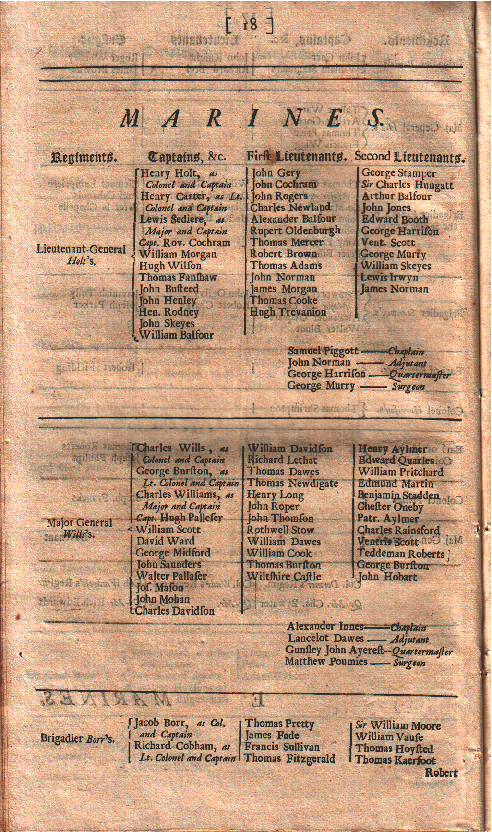
One of those scarce contemporary publications: A Regimental list of the half-pay officers for the year, 1714. According to the English Short Title Catalogue only less than a dozen copies are known in libraries in Britain and the United States.

This list, published by order of the House of Commons, shows all officers that were reduced, i.e. placed on half-pay, after the War of the Spanish Succession. And, as such, is a good source for tracing the careers of officers and, of course, the reduction of the army after the war in general. The list gives also an impression of officers available for the military. Not surprisingly, many of the officers are found in the regiments raised under George I after 1715.

Below an example page showing several of the regiments of marines that were disbanded in 1713.


Friday, 20 January 2012

Neutrality Corps of 1710

In the first decade of the 18th Century two great wars were raging over Europe. The war over the Spanish inheritance was fought in the Spanish-Netherlands, the Rhineland, the Iberian Peninsula and several other regions. In the northern and eastern parts of Europa a conflict was fought, The Great Northern War, with Sweden, Denmark, Russia and Saxony (- Poland) being the main belligerents.

As the Great Northern War was fought in parts of the Holy Roman Empire fear existed that the war might mix with the war over the Spanish succession. The two treaties of Altranstädt of 1706 and 1707 (peace between Sweden and Saxony, and treaty between Sweden and the Emperor) took away the tension for some time. Of interest is to note that in 1707 part of the Saxon army was taken into pay of the Maritime powers.

However, in 1709 the Swedish king Karl XII was defeated by the Russians at Poltava, leading to the former's voluntary exile into Ottoman territory. This created some sort of a void in the Baltic area with Russia, Denmark and Saxony looking with much interest at Swedish territories in the region. The expected return of Karl XII and renewal of the war in the Holy Roman Empire was feared. Moreover, with the war spreading into these Swedish possessions of the Empire it was feared that Brandenburg-Prussia and Hanover might be involved as well. Which would obviously influence their part in the war against France.

On 31 March 1710 the Maritime Powers and the Emperor signed the convention of the Hague. This convention declared for the neutrality of the Swedish possessions in the Empire. In order to enforce this neutrality the signers of the convention, together with several other German powers, agreed to contribute to a corps of Neutrality. The size of the corps was set at 15,400 foot and 3,000 horse. England and the Dutch Republic would contribute six battalions each, in total 8,400 men. Other contributors were the Emperor, Prussia, Hanover, the Palatinate, Mainz, Hessen-Kassel, Münster, Mecklenburg and Wolfenbüttel.

Though the situation remained strained throughout 1710, and several contingents had already marched into Silezia, the Neutrality Corps did not have to come into action. Not because of the corps' deterrent effect, but because the events in the region, and return of the Swedish king, did not proceed as fast as expected.

 
(above image from Feldzüge des Prinzen Eugen von Savoyen XII. Band.)

Hostilities were resumed in 1711 anyway and the Great Northern War would continue until 1721. It also remains to be questioned how effective the corps would have been in case it should have to come into action.

Monday, 9 January 2012

Portuguese regiments in British pay

English, Scots and Irish regiments of the British Army can provide for a great deal of research pleasure for the student of British military history and the lineage addict aficionado. Foreign regiments in British service provide an additional challenge when it comes to finding proper details of the regiments in question. When found, details are often sketchy, incomplete and they may even be contradicting. Adding to the confusion is the broad range of regiments that can be called foreign.

As could be read on this blog before a large number of German troops were in English pay during the Nine Years' War and the War of the Spanish Succession. Such troops entered English pay and service through contracts signed between England and the German state in question. Terms of service and pay were laid down in the contract. Huguenot regiments are also found in English service, and they can be considered foreign as well. Their origin, and reasons for existence differed from that of, for example, the German regiments. In 1708-09 we find a number of Portuguese regiments entering English pay, with yet another background. (The need for more men and bayonets is in most cases probably the ultimate reason why a regiment came into being anyway.) 

By late 1708, as various English regiments had been disbanded, reduced or merged in 1707 and 1708, five new regiments were to be formed in Portugal as replacements: one regiment of dragoons and one of foot. These regiments were to be formed from Portuguese [soldiers], but officered by English and, mostly, French Huguenots. The British treasury paid for the regiments. Commissions were given without date, to be filled in Portugal, and did not exceed the rank of lieutenant-colonel. Though information was not found, the colonelcies were most likely bestowed on Portuguese. Because the regiments were Portuguese, the king of Portugal objected against the idea of having French Protestants commanding his regiments. This delayed the completion of the regiments, which did not happen before summer 1709. By the time the regiments were fully embodied, it was also decided to reorganize the four regiments of foot into five additional regiments of dragoons.

The History of the Reign of Queen Anne for 1709 gives a list of colonels, lieutenant-colonels and majors:

Since the regiments appear in precedence lists compiled after the war it seems likely that the regiments were considered native some time afterwards. In 1712 the following colonels are listed (in order of precedence of their regiment):
  • Balthasar de Foissac
  • Hunt Withers
  • Jean Desbordes
  • Constantine de Magny
  • Paul de Gually
  • Joseph de Sarlande
Five of the six colonels are clearly French Huguenots. To add to be confusion, another regiment of dragoons commanded Charles de la Bouchetière, also a Hueguenot, is often mentioned together with the regiments discussed above.

All six regiments of dragoons mentioned above were disbanded by 1712 and its officers were placed on half-pay. This seems also an indication that at some point the regiments were no longer foreign.

Friday, 2 December 2011

Thomas Erle's regiments

Students of the British army of the late 17th and early 18th centuries will know that in those days regiments were usually single battalion organizations. That means that the strength of a regiment matches that of a battalion: somewhere between 600 and 800 men divided into about a dozen companies.

There were, of course, exceptions. Most prominent are the regiments of foot guards. These regiments had a larger number of companies, with a somewhat larger establishment, and could, probably therefor, spawn several battalions to serve somewhere.

(Here I explicitly void using the phrasing 'split into several battalions'. From literature it seems that the battalion was foremost an ad-hoc tactical formation. The concept of a battalion as a permanent administrative entity was something for the future. Thus, a regiment of foot guards, say the Coldstreams with 14 companies, could be divided into two battalions in the field or for manoeuvres. But this does not apply that something existed as a 1st and 2nd Battalion.)


One famous general of the Nine Years' War and War of the Spanish Succession was Thomas Erle. In the spring of 1689, when the English army was increased in size, Erle was given a colonelcy of one of the newly raised regiments. It was quite exceptional that he would obtain the colonelcy of yet another regiment in January 1691, namely the regiment of the late Francis Luttrell (the future Green Howards of North Yorkshire). This regiment was raised in November 1688, immediately after the Dutch invasion and in support of William III.

(Erle's first regiment served in Ireland until 1691, and was in garrison in Plymouth(?) afterwards. It also took part in the abortive action against Brest in 1694. His second regiment, Luttrell's, was in Plymouth until 1692 when it proceeded to Flanders for the rest of the war.)

Now is becomes a little tricky how these regiments were related to each other. Some sources state that Erle's first regiment was sometimes known as the 2nd Battalion of his (larger) regiment (because is was junior to his second regiment). Probably this is a modern day interpretation (imposing modern concepts on the past).

From the Calendar of State Papers Domestic a few things become (more or less) clear:
1. Commissions in the regiment of Erle do not differentiate between one of the two regiments. So it seems that both regiments were combined as a new regiment, or that is was treated as one.
2. There is no reference to a 1st or 2nd battalion. However, there is sometimes reference to 'his other regiment'.

A few snippets:
On 22 March 1692 we find
  John Pitt, clerk, to be chaplain of the Irish battalion belonging to Col. Thomas Earle's regiment of foot.
and on 12 April 1692, related to the weak garrison of Plymouth
There now are only ten companies of Colonel Earle's regiment in garrison at Plymouth, which by reason of the great drafts for his other regiment lately gone to Flanders, which was recruited out of this, are very weak, and most of them newly raised men.
Finally, on 28 April 1694, probably in preparation of the Camaret Bay operation
Whereas the following several battalions and regiments of foot are to encamp near Portsmouth, viz.: one battalion detached out of our first, second, and Dutch regiments of foot guards; thirteen companies of Colonel Earle's regiment, Lord Cutts' whole regiment, and Colonel Venner's whole regiment; the said battalions and regiments [...]
This last quote illustrates, in my opinion, that Erle's regiment was larger than the usual 13 companies to a regiment. In the yearly estimates for the army presented to Parliament both regiments/battalions of Erle are listed separately, however. One with the additional 'formerly Luttrell's', and the other with 'from Ireland'.